Choosing the Best Soft Plastics for Largemouth Bass
Navigate the vast world of soft plastic lures to find the perfect baits for largemouth bass. Learn about types, colors, and rigging for success.
<h1>Choosing the Best Soft Plastics for Largemouth Bass</h1>
<p>For any serious bass angler, soft plastic lures are an indispensable part of their arsenal. Their versatility, realistic action, and wide range of shapes and colors make them incredibly effective at mimicking natural forage. However, stepping into a tackle shop can be overwhelming with the sheer variety available. How do you choose the "best" soft plastics for largemouth bass? The answer, as with much in fishing, depends on the conditions, but understanding the main categories and their applications will give you a significant edge.</p>
<p>Soft plastics excel because they offer a natural feel and often a natural scent, encouraging bass to hold on longer, giving you more time for a solid hook set. They can be fished in nearly any type of cover, from open water to thick vegetation, making them a go-to choice for anglers of all skill levels.</p>
<h2>Understanding Soft Plastic Categories</h2>
<p>Soft plastics aren't a one-size-fits-all solution. Each category is designed to excel in specific situations and mimic particular prey items.</p>
<h3>1. Stick Baits (e.g., Senkos, wacky worms)</h3>
<ul>
<li><b>Description:</b> Simple, cylindrical worms, often salt-impregnated for a faster fall and enticing wobble.</li>
<li><b>Best For:</b> Finesse fishing, post-frontal conditions, pressured fish, shallow water, clear water.</li>
<li><b>Rigging:</b> Wacky rig, Neko rig, Texas rig, weightless.</li>
<li><b>Why They Work:</b> Their subtle, undulating fall is incredibly natural and triggers strikes from even finicky bass.</li>
</ul>
<h3>2. Worms (e.g., Curl-tail, Straight-tail, Ribbon-tail)</h3>
<ul>
<li><b>Description:</b> The classic. Available in a huge array of lengths (4-12 inches) and tail designs.</li>
<li><b>Best For:</b> All-around bass fishing, pitching into cover, dragging on the bottom, deep water.</li>
<li><b>Rigging:</b> Texas rig, Carolina rig, shaky head, Neko rig, drop shot.</li>
<li><b>Why They Work:</b> Mimic natural worms or eels. The tail action can vary from subtle (straight-tail) to aggressive (ribbon-tail).</li>
</ul>
<h3>3. Creature Baits (e.g., craws, lizards, beaver-style baits)</h3>
<ul>
<li><b>Description:</b> Uniquely shaped plastics with appendages that create disturbance and vibration.</li>
<li><b>Best For:</b> Punching heavy cover, flipping into dense vegetation, targeting bass feeding on crawfish, dirty water.</li>
<li><b>Rigging:</b> Texas rig, jig trailers, punching rigs.</li>
<li><b>Why They Work:</b> Their bulky profile and active appendages displace a lot of water, making them easy for bass to detect in heavy cover or low visibility.</li>
</ul>
<h3>4. Swimbait/Paddle Tail Baits</h3>
<ul>
<li><b>Description:</b> Designed to imitate baitfish with a realistic profile and a paddle tail that kicks enticingly.</li>
<li><b>Best For:</b> Open water, schooling bass, imitating shad or bluegill, search bait.</li>
<li><b>Rigging:</b> Jig head, swimbait hook (weighted or unweighted), A-rig.</li>
<li><b>Why They Work:</b> Highly realistic movement and vibration. Excellent for covering water and triggering reaction strikes.</li>
</ul>
<h3>5. Grubs (e.g., single-tail, double-tail)</h3>
<ul>
<li><b>Description:</b> Simple, compact baits with a curly tail (or two) that vibrates quickly.</li>
<li><b>Best For:</b> Smallmouth bass, crappie, light tackle, clear water, jig trailers.</li>
<li><b>Rigging:</b> Jig head, spinnerbait trailer.</li>
<li><b>Why They Work:</b> Their small profile and active tail make them a great "meal" for a variety of fish.</li>
</ul>
<h2>Choosing the Right Color</h2>
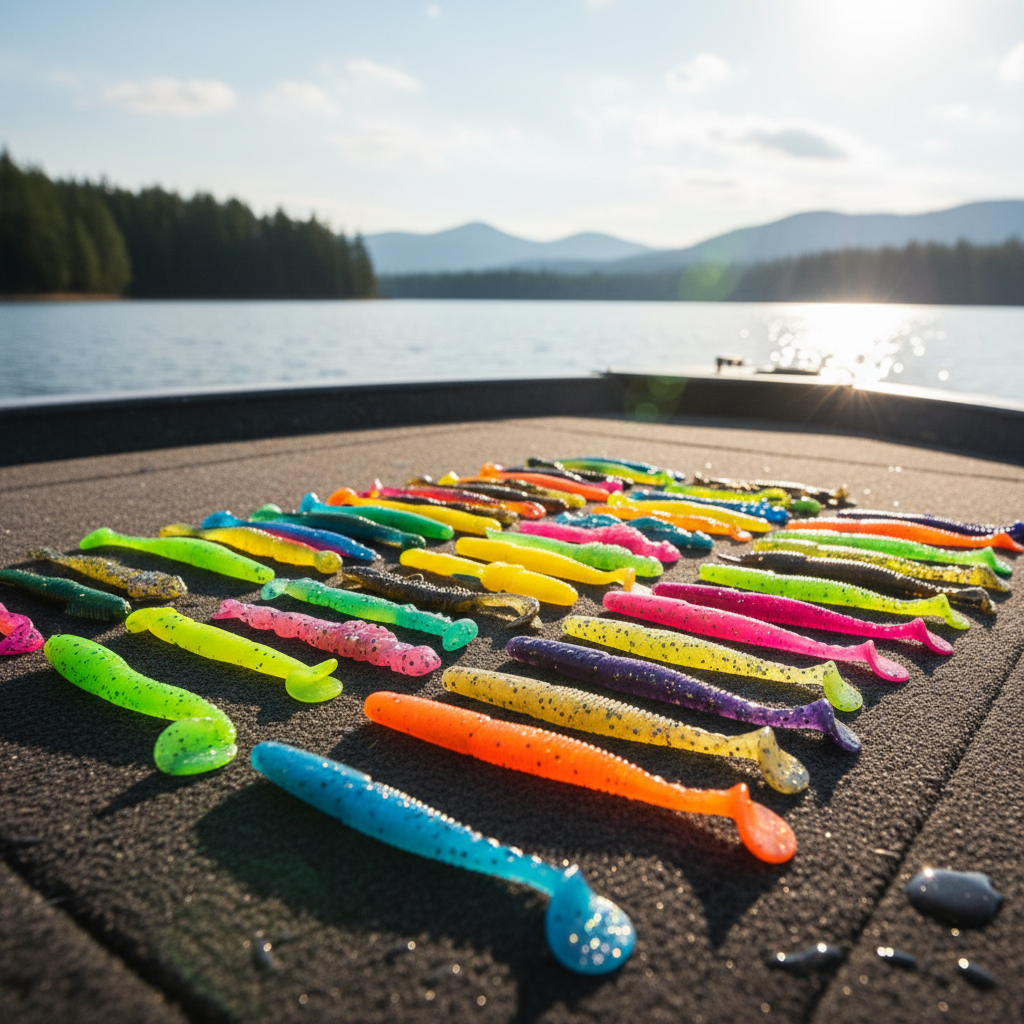
<p>Color choice can be as important as lure shape. While there are countless options, a few general rules apply:</p>
<ul>
<li><b>Clear Water:</b> Natural colors like green pumpkin, watermelon, browns, and transparent shad patterns.</li>
<li><b>Stained/Dirty Water:</b> Brighter colors like black and blue, junebug, or chartreuse. These offer better contrast.</li>
<li><b>Overcast/Low Light:</b> Darker colors or those with UV enhancers can be effective.</li>
<li><b>Matching Forage:</b> Always consider what the bass are eating. If it's crawfish, use red or brown patterns. If it's shad, use silver or white.</li>
</ul>
<p>Don't be afraid to experiment! Sometimes an "unnatural" color can trigger a reaction bite.</p>
<h2>Rigging for Success</h2>
<p>The way you rig your soft plastic significantly impacts its action and effectiveness. Some popular rigs include:</p>
<ul>
<li><b>Texas Rig:</b> Weedless, great for heavy cover. Use a bullet weight.</li>
<li><b>Carolina Rig:</b> Excellent for covering open water and targeting deeper fish. Uses a heavy sinker and a leader.</li>
<li><b>Wacky Rig:</b> Nose-hooked or center-hooked for an irresistible, subtle wobble.</li>
<li><b>Shaky Head:</b> A jig head with a screw-lock keeper, providing a "standing" presentation.</li>
<li><b>Drop Shot:</b> Suspends the bait above the weight, perfect for finicky fish (as discussed in our guide to drop shot fishing).</li>
</ul>
<p>Having a diverse selection of hooks and weights, easily organized in a compact tackle organizer, will ensure you're ready for any rigging scenario.</p>
<p>Ultimately, the "best" soft plastic is the one that catches fish. Start with a variety of the main categories and experiment with colors and rigging. Pay attention to what the bass are telling you, and you'll soon build a go-to collection that consistently puts fish in the boat.</p>